Water leaks are no longer diagnosed by guesswork, wall removal, or broad excavation. In 2026, the standard for professional leak investigation is targeted, evidence-based testing that reduces disruption while improving accuracy. Modern providers now combine multiple diagnostic tools to confirm whether water is escaping, where it is escaping, and what conditions are affecting the line or fitting involved.
For property owners seeking leak detection Perth services, the main advantage of newer technology is precision. Instead of relying on visible water damage alone, technicians can use sound analysis, temperature mapping, gas tracing, moisture assessment, pressure testing, and digital reporting to narrow the search area before repairs begin. That shift matters in residential homes, strata properties, commercial facilities, and sites with concealed pipework.
Why Modern Leak Detection Has Changed
Traditional leak finding often depended on symptoms such as damp walls, surface cracking, mould, unexplained water bills, or pressure loss. Those signs still matter, but they are not enough on their own. Water can travel far from the point of failure, and different building materials can hide or distort the true source.
Modern systems improve the process by combining non-destructive inspection tools with technician interpretation. Acoustic devices detect the sound profile created by pressurised water escaping from a pipe. Thermal cameras help identify temperature variation associated with moisture movement or evaporative cooling. Tracer gas methods can locate leaks that are difficult to detect acoustically, especially in certain buried or concealed pipe systems. Advanced digital tools can also store measurements, compare test results, and produce more structured findings for the client. These methods are widely used across current leak detection equipment categories from specialist manufacturers and inspection brands.
Acoustic Sensing
Acoustic sensing remains one of the most important technologies in leak diagnostics. When water escapes under pressure, it creates a noise signature. That sound can travel through pipe walls, surrounding soil, slab structures, and connected building materials. Sensitive listening devices help technicians identify differences in frequency, intensity, and pattern so they can narrow the likely leak zone.
Modern acoustic tools are more refined than older listening rods. They may include ground microphones, digital correlators, amplified sensors, and software that filters background noise. In practical terms, this is useful where the leak is underground, beneath concrete, or behind finishes that cannot be opened blindly.
Acoustic testing works best when the system is under pressure and the environment allows a usable sound path. Metal pipes, certain pressurised lines, and steady leak conditions can produce strong acoustic results. However, plastic pipes, low-pressure systems, external noise, or very small intermittent leaks can reduce reliability. That is why a capable leak detection plumber Perth operator does not treat acoustic equipment as a standalone answer. It is one diagnostic layer within a broader process.
Thermal Imaging
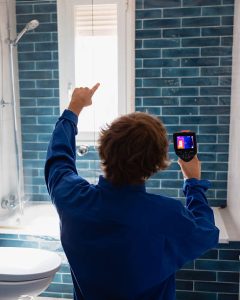
Thermal imaging is another widely used diagnostic method. Infrared cameras do not see water directly. They detect surface temperature differences. When water escapes into surrounding materials, it can change the thermal pattern of floors, walls, ceilings, and external surfaces. A trained technician can interpret those differences to identify suspicious areas for further testing.
This is particularly useful where leaks affect internal wall cavities, underfloor heating systems, bathroom areas, ceilings below wet rooms, and slab-adjacent zones. Thermal imaging can also support moisture investigations by revealing the spread pattern of affected materials.
Its value lies in speed and coverage. Large areas can be scanned quickly without opening finishes at random. However, interpretation matters. Temperature differences can also be influenced by sunlight, shading, HVAC performance, insulation gaps, air movement, or recent water usage. Thermal cameras are therefore most effective when used alongside moisture readings, pressure tests, and site knowledge. Current handheld thermal cameras are designed for inspection and troubleshooting across building diagnostics and related applications.
Tracer Gas Detection
Tracer gas is one of the most useful options when conventional methods cannot provide enough certainty. In this approach, the target pipe section is prepared and a test gas is introduced. That gas escapes through the leak opening and rises or migrates to a detectable area, where a sensitive instrument identifies it.
A common tracer gas mixture used in water leak detection is 95% nitrogen and 5% hydrogen, selected because it is highly detectable and commonly described by manufacturers as suitable for pinpointing small leaks. Specialist leak detection systems are built specifically around this mixture and its sensing requirements.
Tracer gas can be particularly effective for concealed pipework, plastic lines, underfloor heating circuits, and situations where the sound signature is weak. It is also useful where the leak is small but persistent, and where access limitations make invasive investigation undesirable.
The main strength of tracer gas testing is that it can confirm a path of escape even where sound-based methods struggle. The limitation is that it requires correct preparation, isolation, and interpretation. It is not simply a matter of introducing gas and waiting. A professional operator must understand the pipe network, pressure conditions, material types, and likely migration paths through surrounding surfaces.

Advanced Diagnostics Beyond a Single Tool
The most effective services in 2026 do not depend on one device. They use a layered diagnostic model. This may include:
Pressure testing to confirm whether the system is losing integrity.
Moisture meters to assess the extent and direction of water impact.
Borescopes for confined visual inspection.
Data logging to track pressure change over time.
Pipe and service tracing to understand route location before intrusive work.
Digital image capture and reporting to document findings.
This matters because leaks are rarely identical. A pinhole in copper, a failed fitting under a slab, a cracked PVC joint, a shower breach, and an irrigation line fault all behave differently. A technician who uses multiple diagnostic inputs can separate the actual leak source from secondary moisture symptoms.
That is also why clients should look beyond simple marketing claims when comparing providers. A credible leak detection Perth service should be able to explain what tools are appropriate for the suspected leak type, what evidence supports the diagnosis, and where uncertainty still exists.
Why Interpretation Matters as Much as Equipment
Technology has improved the speed and accuracy of detection, but the result still depends on judgement. Equipment can generate readings, images, and signals, yet those outputs must be interpreted in context. Surface moisture does not always indicate the entry point. A hot or cool area on a thermal camera does not always confirm a pipe defect. Acoustic noise can reflect through surrounding structures and mislead the search if used in isolation.
An experienced leak detection plumber Perth specialist knows how to compare one test result against another before recommending access or repair. That is the difference between a technology-assisted inspection and a technology-led guess.
Conclusion
The technology behind modern leak detection services in Perth now centres on precision, reduced disruption, and stronger diagnostic evidence. Acoustic sensing, thermal imaging, tracer gas, and advanced supporting tests each serve a specific purpose. When used correctly, they help isolate concealed leaks with far less unnecessary demolition than older methods required.
For property owners in 2026, the key issue is not whether technology exists, but whether it is being applied properly. The most reliable service is one that combines the right tools with informed interpretation, clear reporting, and a measured approach to confirming the source before repair work begins.